
 Get Weekly Possibilities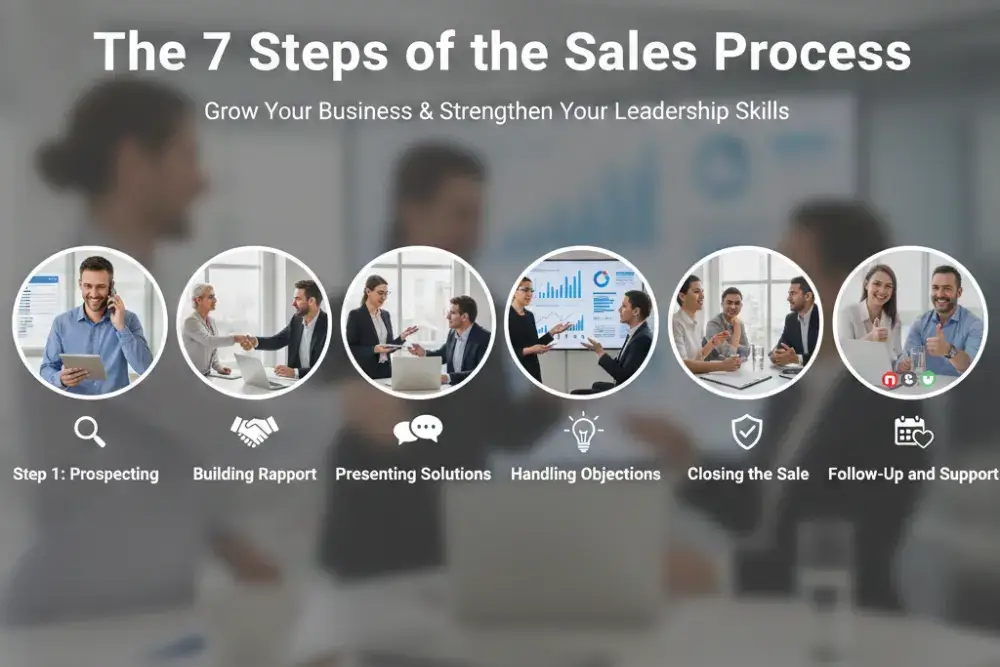
A consistent sales process is not about pressure or persuasion. It is about clarity, alignment, and leadership. When sales conversations feel scattered or unpredictable, results suffer—not because of effort, but because of structure. A clearly defined sales process allows business professionals to lead conversations with confidence, respond effectively to objections, and create trust at every stage of the buyer’s journey. Understanding the 7 steps of the sales process allows business professionals to bring structure, confidence, and consistency to every sales conversation.
The following seven steps of the sales process provide a practical framework that supports business growth while strengthening communication strategies and leadership development. When applied intentionally, this process becomes repeatable, measurable, and scalable.
Step 1: Prospecting with purpose
Prospecting is not about volume alone; it is about relevance. Effective prospecting focuses on identifying individuals or organizations that are genuinely aligned with what you offer. This requires clarity around your ideal client, the problems you solve, and the outcomes you help achieve.
Strong prospecting strategies include:
- Identifying decision-makers who are experiencing a specific challenge your solution addresses.
- Researching industries, roles, and growth stages where your offering is most valuable.
- Using networking, referrals, and targeted outreach rather than relying solely on cold tactics.
Prospecting done well positions sales as a service, not an interruption.
Step 2: Building rapport through credibility and presence
Rapport is built through presence, not personality. Business professionals establish rapport by demonstrating respect, curiosity, and professionalism. This stage is where communication strategies matter most, because prospects decide whether they feel understood.
Rapport-building includes:
- Listening without interrupting or prematurely offering solutions.
- Acknowledging challenges without minimizing them.
- Matching tone and pace to create conversational alignment.
Strong rapport lays the foundation for trust, which is essential for higher-value sales conversations.
Step 3: Conducting a meaningful needs analysis
The needs analysis is where many sales processes break down. Asking surface-level questions leads to surface-level solutions. Effective needs analysis uncovers the true cost of the problem and the impact of inaction.
This step requires asking questions that explore:
- What is currently not working and why it matters.
- What has already been tried and what stalled progress.
- How the issue affects revenue, time, morale, or leadership effectiveness.
A strong needs analysis positions you as a strategic partner rather than a vendor.
Step 4: Presenting solutions that align with outcomes
Presenting solutions is not about listing features. It is about connecting your offering to the outcomes the prospect values most. Business professionals who excel here speak in terms of results, not deliverables.
Effective solution presentation includes:
- Linking your approach directly to the challenges uncovered in the needs analysis.
- Explaining how your solution supports long-term business or leadership goals.
- Clarifying what success looks like after implementation.
This step reinforces value and reduces resistance by maintaining alignment.
Step 5: Handling objections with confidence and clarity
Objections are rarely rejections. They are requests for clarity. Whether the concern is cost, timing, or authority, how objections are handled reflects leadership presence.
Effective objection handling involves:
- Listening fully before responding.
- Acknowledging the concern without defensiveness.
- Reframing objections within the context of outcomes and priorities.
When objections are addressed calmly and strategically, trust deepens rather than erodes.
Step 6: Closing the sale with alignment
Closing is not a tactic; it is a transition. When the prior steps are executed well, closing becomes a natural next step rather than a moment of pressure.
Effective closing includes:
- Summarizing the agreed-upon challenges and solutions.
- Clarifying next steps, timelines, and expectations.
- Inviting commitment in a clear and professional manner.
A confident close reflects leadership and respect for the decision-making process.
Step 7: Follow-up and long-term relationship building
The sales process does not end at the signature. Follow-up and ongoing support are where trust becomes loyalty. This step is critical for referrals, renewals, and long-term growth.
Strong follow-up practices include:
- Ensuring smooth onboarding and clear communication post-sale.
- Checking in proactively rather than reactively.
- Maintaining alignment with evolving business needs.
Consistent follow-up reinforces credibility and strengthens professional relationships.
Sales process mastery through leadership development
A structured sales process supports more than revenue—it develops leadership skills. Communication, empathy, strategic thinking, and accountability are all refined through disciplined sales conversations.
Business coaching helps professionals evaluate where their sales process breaks down, refine communication strategies, and lead conversations with clarity rather than urgency. For leaders who want to strengthen their sales process while improving confidence and consistency, a free coaching session can help identify where small adjustments create measurable results.