
 Get Weekly Possibilities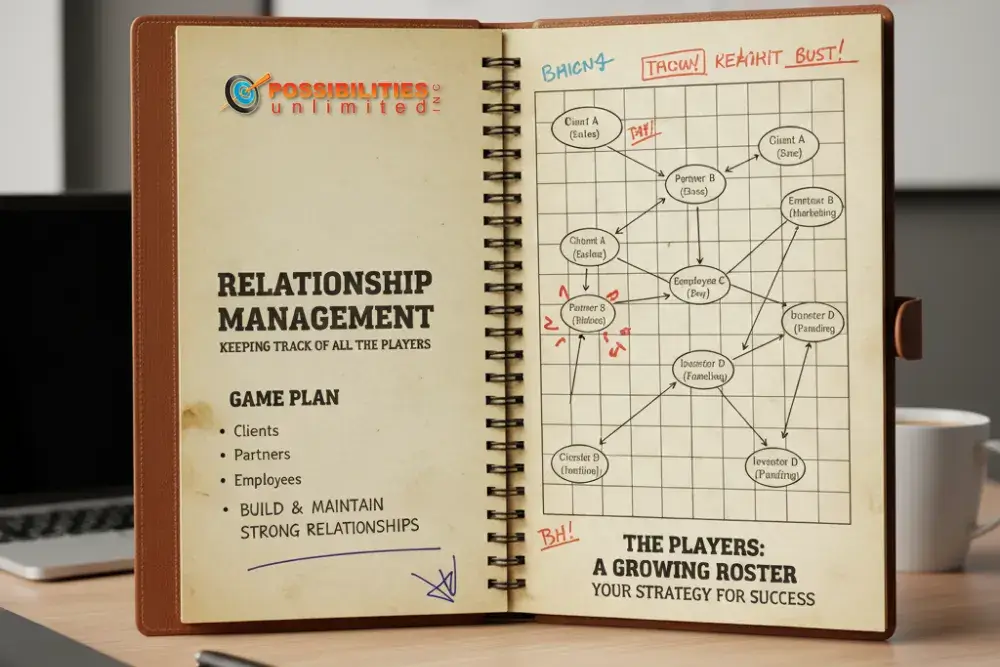
Relationship management for growing businesses becomes increasingly complex as clients expand, teams evolve, partners shift, and internal roles change.Clients expand, teams evolve, partners shift, and internal roles change. Relationship management becomes less about remembering names and more about intentionally managing communication, expectations, and trust across an expanding network of stakeholders. For business professionals, the ability to keep track of all the players is directly tied to leadership effectiveness, business performance, and long-term stability.
Relationship management as a leadership discipline
Relationship management is not a soft skill reserved for HR or customer service. It is a leadership discipline that influences decision-making, accountability, and culture. Leaders who actively manage relationships understand how information flows, where breakdowns occur, and which connections require more attention.
At its core, relationship management means:
- Knowing who is involved, why they matter, and how they influence outcomes
- Maintaining clarity around roles, expectations, and communication norms
- Recognizing when relationships need repair, reinforcement, or recalibration
- Ensuring people feel seen, heard, and respected as the business evolves
Without intentional relationship management, even strong strategies can stall. Misalignment, assumptions, and unspoken frustrations often show up as missed deadlines, disengagement, or unnecessary conflict.
Why relationship management becomes harder as businesses grow
Early-stage businesses often rely on informal communication and close proximity. As teams expand, those informal systems break down. Leaders who once “knew everything” find themselves reacting instead of anticipating.
Common challenges include:
- Losing visibility into who owns what across departments or projects
- Inconsistent communication styles that create confusion or tension
- Clients feeling overlooked as volume increases
- Employees unclear on priorities or decision authority
Effective relationship management replaces guesswork with structure—without removing the human element.
Communication strategies that support relationship clarity
Communication is the engine of relationship management. Leaders who communicate intentionally reduce friction and build trust, even in complex environments.
Establish consistent communication rhythms
Consistency builds confidence. Regular check-ins, status updates, and touchpoints prevent small issues from becoming major problems. These do not need to be lengthy meetings, but they do need to be predictable.
Strong communication rhythms help:
- Surface concerns before they escalate
- Reinforce accountability without micromanaging
- Keep stakeholders aligned on priorities and progress
- Create psychological safety for honest dialogue
Clarify expectations early and often
Many relationship issues stem from unspoken assumptions. Leaders who clearly articulate expectations—around timelines, quality, decision-making, and communication—reduce misunderstandings.
Clear expectations support relationship management by:
- Eliminating ambiguity that leads to frustration
- Helping people understand how success is defined
- Providing a shared reference point when adjustments are needed
- Making accountability feel fair rather than personal
Listen for what is not being said
Effective leaders listen beyond words. Tone, hesitation, and silence often reveal more than direct statements. Relationship management improves when leaders create space for honest feedback and actually act on what they hear.
This type of listening:
- Builds trust by showing people they matter
- Reveals early warning signs of disengagement
- Strengthens collaboration across roles and teams
- Improves decision-making with real context
Using systems without losing the human element
As businesses scale, systems become necessary. Tools such as CRMs, project management platforms, and shared documentation help leaders keep track of relationships, responsibilities, and communication history.
Used correctly, systems support—not replace—human connection. They allow leaders to:
- Track interactions and commitments consistently
- Ensure follow-through without relying on memory
- Reduce dropped balls during transitions or growth phases
- Maintain continuity even as team members change
The key is intentional use. Systems should create clarity, not bureaucracy. When paired with strong communication strategies, they free leaders to focus on higher-level relationship building.
Leadership development and relationship intelligence
Leadership development plays a critical role in relationship management. Technical skill alone does not sustain relationships. Emotional intelligence, adaptability, and self-awareness are what allow leaders to manage diverse personalities and priorities.
Leadership development strengthens relationship management by helping leaders:
- Understand how their communication style impacts others
- Navigate difficult conversations with confidence and respect
- Adjust leadership approaches based on context and individual needs
- Build trust across authority levels and functions
Leaders who invest in these skills create environments where people collaborate instead of compete and where alignment replaces confusion.
Relationship management as a strategic advantage
Businesses that manage relationships intentionally move faster with less friction. Decisions are clearer, execution improves, and trust compounds over time.
Relationship management is not about pleasing everyone. It is about creating clarity, accountability, and mutual respect—so people know where they stand and how they contribute.
Possibilities Unlimited works with business professionals to strengthen relationship management through practical business coaching, leadership development, and communication strategies. For leaders who want to improve how they manage people, partners, and clients without adding unnecessary complexity, a focused conversation can uncover where relationships are supporting growth—and where they may be holding it back. A free coaching session can help identify simple, effective ways to keep track of all the players while leading with confidence and clarity.