
 Get Weekly Possibilities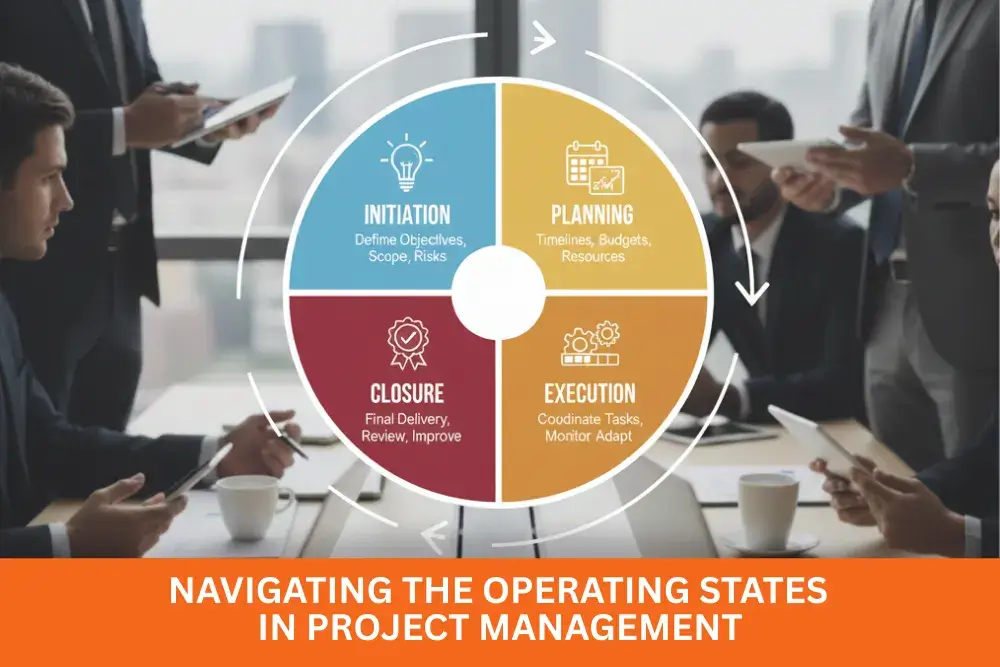
Navigating operating states in project management is one of the most overlooked leadership skills in growing organizations. Projects rarely fail because of effort or intent; they fail because leaders apply the wrong behaviors, communication strategies, or expectations at the wrong time. Understanding how operating states shift—and how leadership must shift with them—allows business professionals to move projects forward with far less friction and far better results.
Why operating states matter in modern business
Every project moves through distinct operating states, each requiring a different leadership approach. Problems arise when leaders attempt to manage execution issues with planning conversations, or when teams are pushed for speed before clarity exists. Business coaching often reveals that frustration stems not from poor performance, but from misaligned operating states.
When leaders understand operating states, they gain the ability to:
- Reduce confusion and rework by matching decisions to the current state
- Improve communication strategies across teams and stakeholders
- Increase accountability without creating resistance or burnout
- Move projects forward with greater predictability and confidence
The initiation operating state: establishing clarity and commitment
The initiation state is where success is either set up or quietly undermined. This is the phase where purpose, scope, and ownership must be clearly defined. Leaders often underestimate this state, assuming alignment exists when it does not.
Effective initiation requires leaders to clearly answer several critical questions:
- Why does this project exist, and what problem is it solving?
- What does success look like in concrete terms?
- Who owns outcomes, decisions, and escalation paths?
- What constraints, risks, or assumptions must be acknowledged upfront?
Communication strategies during initiation should emphasize listening as much as direction. Leaders must confirm shared understanding rather than rely on agreement alone. Business coaching often helps leaders recognize where assumptions replace clarity, which later shows up as delays or resistance.
The planning operating state: structuring the path forward
The planning state translates intention into structure. This is where timelines, resources, dependencies, and responsibilities are defined. Strong leadership during planning balances realism with ambition, ensuring teams are challenged without being set up for failure.
During this operating state, leaders must focus on:
- Breaking large objectives into manageable phases or milestones
- Clarifying roles to eliminate overlapping ownership or gaps
- Establishing decision-making authority to prevent bottlenecks
- Creating communication rhythms that support progress tracking
Leadership development is particularly important here, as planning requires the discipline to slow down enough to think. Leaders who rush planning often compensate later with excessive oversight during execution. Clear planning reduces the need for control later.
The execution operating state: maintaining momentum and accountability
Execution is where leadership presence becomes most visible. This operating state demands consistency, adaptability, and the ability to manage progress without micromanaging. Leaders who struggle here often oscillate between disengagement and overcontrol.
Effective execution leadership includes:
- Maintaining focus on priorities as competing demands emerge
- Removing obstacles rather than absorbing tasks themselves
- Reinforcing accountability without creating fear or defensiveness
- Adjusting plans when reality reveals new information
Communication strategies during execution should emphasize clarity and cadence. Regular check-ins are not status meetings alone; they are alignment points where leaders can reinforce priorities, address risks early, and keep teams engaged.
Business coaching frequently helps leaders identify when execution problems are actually leadership or communication issues rather than performance failures.
The closure operating state: completing, learning, and reinforcing trust
Closure is the most neglected operating state, yet it is essential for long-term performance. Many teams move directly from execution into the next initiative without truly completing the current one, leaving unresolved issues and missed learning behind.
True closure involves more than delivery. It requires leaders to:
- Confirm that agreed outcomes were met
- Communicate results clearly to stakeholders
- Acknowledge contributions and effort
- Extract lessons to improve future initiatives
This operating state strengthens organizational trust. When leaders consistently close loops, teams gain confidence that effort leads to recognition and clarity. Closure also reinforces accountability by making results visible rather than assumed.
Communication strategies across all operating states
Communication strategies must evolve as operating states change. Applying a single communication style across all phases leads to misunderstandings and frustration.
- Initiation: Emphasize clarity, intent, and shared understanding
- Planning: Focus on structure, roles, and expectations
- Execution: Reinforce alignment, progress, and problem-solving
- Closure: Highlight outcomes, learning, and recognition
Leadership development helps professionals recognize which conversations belong in which state, preventing premature pressure or delayed decisions.
How business coaching supports leaders navigating operating states
Understanding operating states intellectually is not enough. Leaders must apply them in real time while managing people, pressure, and competing priorities. Business coaching provides a structured environment for leaders to refine this skill.
Through business coaching, leaders gain:
- Clear frameworks for identifying the current operating state
- Improved communication strategies tailored to each phase
- Greater confidence in decision-making and delegation
- Stronger leadership presence during high-pressure execution
For business professionals navigating complex projects or organizational change, a free coaching session can help clarify how operating states are impacting current results. Possibilities Unlimited supports leaders in strengthening execution, improving communication, and developing leadership habits that create momentum instead of friction.