
 Get Weekly Possibilities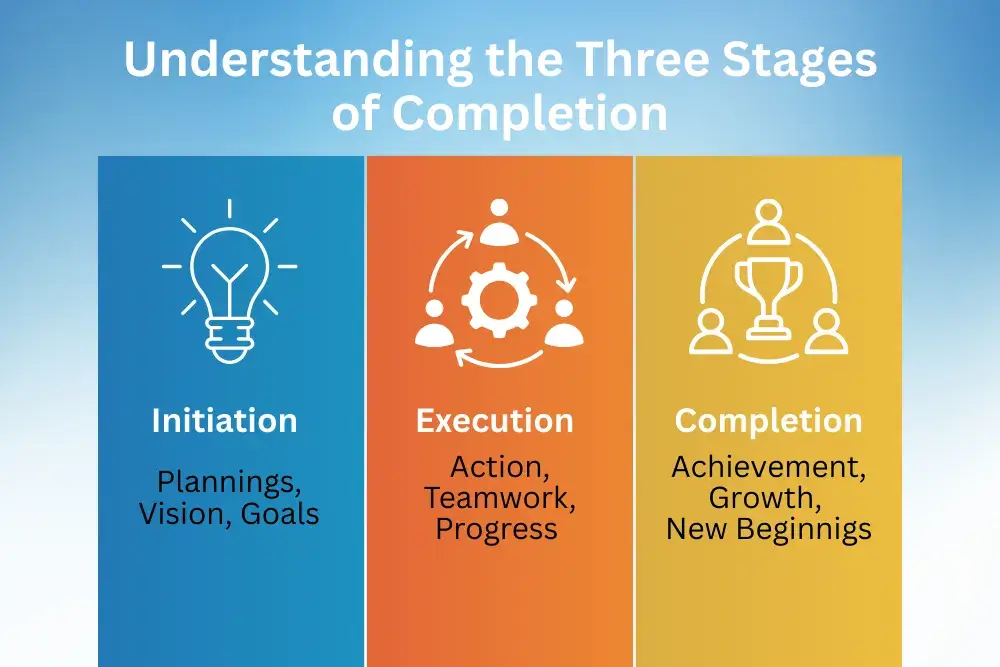
Understanding the three stages of completion is essential for business professionals who want consistent results, stronger leadership, and better execution across projects and initiatives. Many organizations struggle not because of a lack of ideas, but because they fail to move work cleanly from start to finish. When leaders clearly understand how initiation, execution, and completion function as a connected system, they gain the ability to lead with clarity, improve communication strategies, and drive sustainable growth.
Why understanding the three stages matters in business
Every initiative—whether launching a new service, restructuring a team, or refining internal processes—moves through predictable stages. When these stages are misunderstood or skipped, projects stall, accountability breaks down, and teams lose momentum. Business coaching often reveals that breakdowns rarely occur due to effort alone; they occur because leaders are unclear about which stage they are in and what is required at that stage.
Understanding the three stages allows leaders to:
- Set realistic expectations at the right time
- Communicate more effectively with teams and stakeholders
- Allocate resources with greater precision
- Reduce rework, frustration, and missed deadlines
Stage one: initiation and strategic clarity
The initiation stage is where clarity is either created or lost. This stage is not about action; it is about intention, alignment, and commitment. Many leaders rush through initiation, eager to move into execution, only to discover later that expectations were never fully aligned.
Effective initiation requires leaders to clearly define:
- The purpose of the initiative and why it matters
- What success looks like in practical, measurable terms
- Who owns which decisions and responsibilities
- What constraints, risks, or assumptions exist
Strong communication strategies are critical at this stage. Leaders must ensure that all stakeholders share the same understanding of priorities and outcomes. This includes listening for unspoken concerns, clarifying vague language, and confirming alignment rather than assuming it.
Business coaching often supports leaders in slowing this stage down just enough to ask the right questions, which prevents costly misalignment later.
Stage two: execution and disciplined leadership
Execution is where leadership habits are most visible. This stage requires consistency, follow-through, and the ability to manage progress without micromanaging. Execution is not simply about working harder; it is about working with focus and discipline.
During execution, leaders must balance multiple demands:
- Maintaining momentum while managing competing priorities
- Ensuring accountability without creating fear or burnout
- Adjusting plans in response to real-world conditions
- Keeping communication clear as complexity increases
Leadership development becomes especially important during this stage. Leaders who lack confidence in delegation or communication often step in too frequently, unintentionally slowing progress. Others disengage entirely, leaving teams without guidance. Effective leaders stay present, ask questions, and remove obstacles rather than attempting to control every detail.
Execution also benefits from regular checkpoints. These moments are not about status reporting alone; they are opportunities to recalibrate expectations, reinforce priorities, and address emerging challenges before they escalate.
Stage three: completion and organizational learning
Completion is often misunderstood as simply “finishing the work.” In reality, completion is about closure, communication, and learning. Many organizations move immediately from execution into the next initiative without fully completing the current one, leaving unresolved issues and missed insights behind.
True completion involves:
- Confirming that agreed-upon outcomes were achieved
- Communicating results clearly to stakeholders
- Acknowledging contributions and effort
- Reflecting on what worked and what did not
This stage is critical for leadership credibility. When leaders consistently bring work to a clean close, teams develop greater trust and confidence in future initiatives. Completion also strengthens communication strategies by reinforcing transparency and accountability.
Post-completion reviews are especially valuable. These discussions should focus on process improvement rather than blame, allowing organizations to refine how they approach initiation and execution going forward.
Communication strategies across all three stages
Communication is the connective tissue that holds the three stages together. Each stage requires a different communication focus, and leaders who adapt their approach see stronger results.
- During initiation: Emphasize clarity, shared understanding, and commitment
- During execution: Focus on alignment, feedback, and obstacle removal
- During completion: Reinforce transparency, learning, and recognition
When leaders apply the same communication style across all stages, misunderstandings increase. Effective leadership development helps leaders recognize when to ask, when to direct, and when to reflect.
How business coaching supports mastery of the three stages
Understanding the three stages conceptually is one thing; applying them consistently is another. Business coaching helps leaders identify where breakdowns occur most often and why. Some leaders struggle with initiation, others with execution discipline, and many with true completion.
Through business coaching, professionals gain:
- Clear frameworks for managing initiatives from start to finish
- Improved leadership presence during high-pressure execution phases
- Stronger communication strategies that adapt to each stage
- Greater confidence in decision-making and accountability
For business professionals who want to improve results without adding unnecessary complexity, a free coaching session can help clarify how the three stages of completion apply directly to their current challenges. Possibilities Unlimited supports leaders in strengthening execution, improving communication, and building leadership habits that drive consistent, repeatable success.