
 Get Weekly Possibilities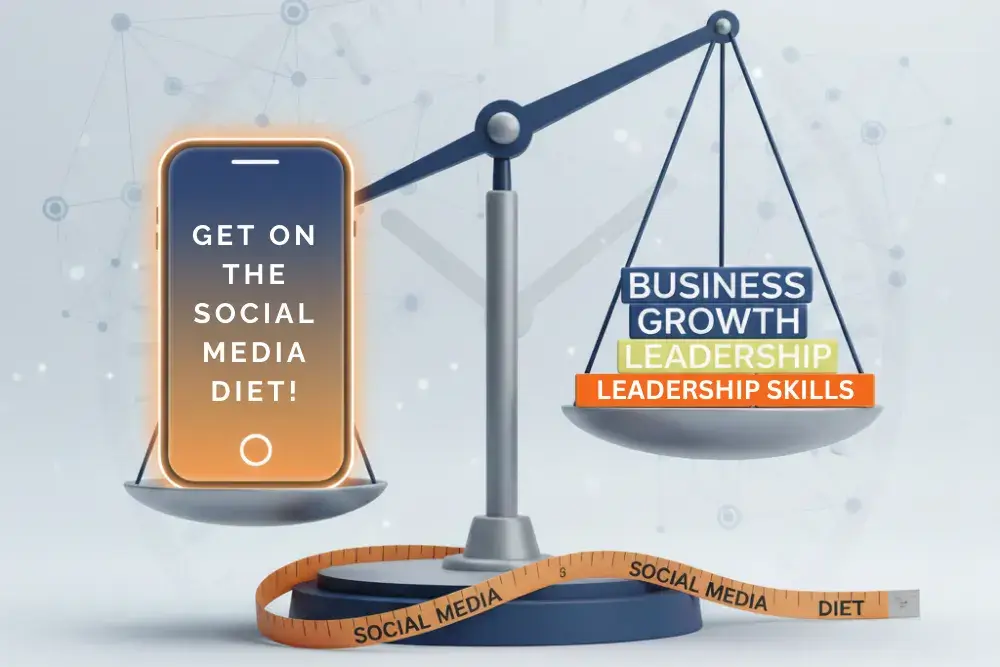
Social media diet for business leaders means using platforms with intention rather than allowing them to drain focus, energy, and results. Social media can be one of the most powerful tools in a business professional’s toolbox—or one of the biggest drains on focus, energy, and results. Many leaders find themselves constantly consuming content, reacting to trends, and posting without a clear strategy. A social media diet is not about eliminating social media altogether. It is about being intentional, disciplined, and strategic in how social media supports your business, leadership development, and communication strategies.
How social media impacts focus, leadership, and decision-making
Social platforms are designed to capture attention. For business professionals, unchecked social media usage can quietly erode strategic thinking, productivity, and clarity. Leaders who spend excessive time scrolling often find themselves reacting instead of leading.
A poorly managed social media presence can also dilute your message. When content lacks direction or consistency, it becomes noise rather than influence. This is why a social media diet begins with awareness—not just of what you post, but how social media affects your mindset and leadership behavior.
When leaders approach social media with intention, they regain control over:
- How their time and attention are allocated throughout the day
- The clarity and consistency of their professional message
- The quality of conversations they are creating with their audience
- The alignment between online presence and real-world business goals
Defining what a social media diet really means
A social media diet is not about posting less for the sake of posting less. It is about aligning activity with outcomes. Just as a healthy diet fuels performance, a disciplined social media approach fuels visibility, credibility, and trust.
This starts with clarity around purpose. Every platform, post, and interaction should support a defined objective. Without that clarity, social media becomes performative instead of productive.
A healthy social media diet helps business professionals:
- Consume content intentionally rather than habitually
- Create content that reflects expertise instead of chasing trends
- Engage in conversations that build relationships, not distractions
- Measure success by business impact, not vanity metrics
Choosing platforms that support your leadership goals
Not every social platform deserves your attention. A disciplined social media diet requires leaders to choose platforms that align with their audience, industry, and communication strengths.
For many business professionals, this means prioritizing platforms where meaningful conversations happen. LinkedIn, for example, often supports leadership development and business coaching conversations more effectively than highly visual or entertainment-driven platforms.
Choosing the right platforms allows leaders to:
- Focus effort where decision-makers already engage
- Communicate with clarity instead of fragmentation
- Build authority through consistency and relevance
- Avoid burnout caused by trying to be everywhere at once
Creating content that adds value instead of noise
One of the most important elements of a social media diet is content discipline. Business leaders often feel pressure to post frequently, even when they have nothing meaningful to say. This leads to diluted messaging and audience fatigue.
High-quality content answers real questions, offers perspective, and demonstrates leadership thinking. It does not need to be complex, but it must be intentional.
Value-driven content typically:
- Addresses challenges your audience is actively facing
- Shares lessons learned from real business experiences
- Encourages thoughtful discussion rather than passive consumption
- Reflects your communication style and leadership values
Business coaching often helps leaders clarify what content aligns with their expertise, making posting simpler and more effective.
Engagement as a communication strategy, not a time sink
Engagement is one of the most misunderstood aspects of social media. Many leaders either ignore engagement entirely or overinvest time responding to everything without purpose.
A social media diet reframes engagement as a communication strategy. Engagement should reinforce relationships, not interrupt productivity.
Intentional engagement includes:
- Responding thoughtfully to comments that invite dialogue
- Participating in conversations that align with your expertise
- Ignoring distractions that do not support your objectives
- Using engagement to deepen trust rather than boost algorithms
This approach allows leaders to remain visible without being consumed by constant interaction.
Setting boundaries that protect leadership focus
Leadership development requires mental space. Without boundaries, social media can fragment attention and undermine strategic thinking.
Effective boundaries might include:
- Designated times for content creation and engagement
- Limiting consumption of non-essential content
- Turning off notifications that interrupt deep work
- Evaluating social media performance monthly instead of daily
These boundaries are not restrictive—they are empowering. They allow leaders to use social media as a tool rather than a distraction.
How business coaching supports a healthier social media approach
Many business professionals struggle with social media not because they lack knowledge, but because they lack alignment. Business coaching helps leaders connect social media activity to broader goals such as revenue growth, leadership visibility, and communication effectiveness.
Through business coaching, leaders often gain:
- Clarity around what role social media should play in their business
- Confidence in communicating expertise without oversharing
- Systems that reduce time spent while increasing impact
- Accountability for maintaining healthy boundaries
Possibilities Unlimited works with business professionals to simplify social media strategies so they support leadership development instead of competing with it. For leaders ready to regain control of their online presence while strengthening communication strategies, a free coaching session can help identify practical ways to implement a sustainable social media diet that aligns with real business results.